Prevent water damage during freeze/thaw cycles
One of the facts of asphalt life is that it cracks. It cracks from extreme heat, and it cracks when the surface freezes and expands. Water, dirt and sand can work their way into and expand hairline cracks into larger cracks. Cracks are difficult to avoid, but the faster you get them sealed up, the chance of significant asphalt wear and underlying deterioration decreases.
Cracking patterns tend to happen in stages, starting with longitudinal cracks, progressing to block cracks, or square/rectangular cracking patterns, then “alligator” or “spider web” cracking, and eventually leading to heaving or complete deterioration. When you’ve reached alligator cracking or heaving, unfortunately the asphalt must be milled and patched or replaced, and is no longer a candidate for sealing.
We can provide a full inspection and free estimate to help determine if you’re a candidate for the crack sealing process.
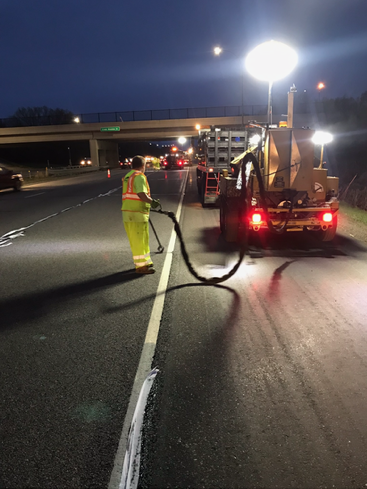
- Prior to crack sealing, we rout any cracks that are 1/4” wide or larger. Routed cracks are then dried and cleared with a hot air lance or forced air wand. Depending on the amount of cracks, a follow up sweep may be requested.
- Cracks are filled with a hot, rubberized material tested and approved by MNDot.
- In traffic scenarios, biodegradable paper is applied to prevent the freshly applied material from tracking or being pulled from the cracks during the cooling process.
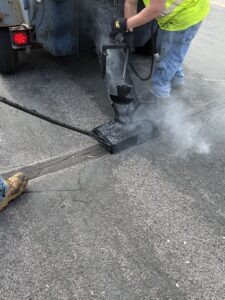
Types of crack sealing:
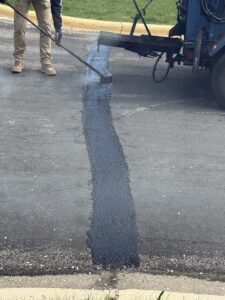
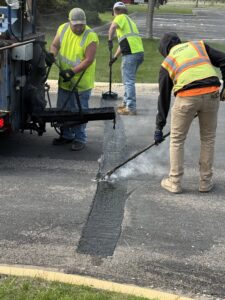
- “Blow and go” or “clean and seal” – Clean the crack and apply hot rubberized material.
- “Route and Seal” – Recommended Method for new cracks, Route out crack prior to cleaning and applying hot rubberized material.
- “Mastic crack sealing” – Mastic crack sealing is best applied to cracks that have sunk or have a dip in them. Mastic is a thicker material with aggregate blended in to fill in deeper and wider depressions.
- Joint Adhesive for asphalt – This is a process used during paving and is applied prior to laying the asphalt. Joint adhesive is installed along the face of a curb or an asphalt cold seam to help bond the different materials together and create a barrier to help prevent water penetration when the joints eventually open up.
- “Crack Special” – Also called Flex Patching, it’s an excellent option for cracks that are too wide for traditional crack seal methods and are creating rideability concerns. After thoroughly cleaning the crack, we apply hot rubberized material blended with fibers. The rubber material is then covered with aggregate to allow traffic flow and good friction. Flex Patching can also be a means of temporary repair to block cracking and alligator cracking if the asphalt chunks are not loose.
- Other – There are various other crack seal methods or materials that can be used in combination with any of the above situations depending on existing conditions and environments.